Kill bacteria with heat
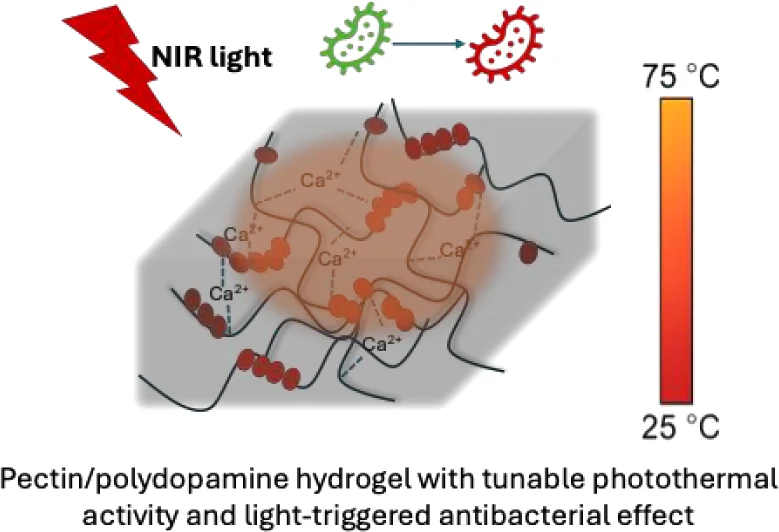
If a dressing can warm up when you need it to, the heat can damage bacteria without any drug. Polydopamine, a polymer inspired by the adhesive proteins of mussels, absorbs near-infrared light and turns it into heat.
A soft gel made from pectin and polydopamine. It heats up under near-infrared light, and the heat kills bacteria on its surface. The idea is a wound dressing that works without antibiotics. We published the work in ACS Omega in 2025.
| Measure | Result | Compared with |
|---|---|---|
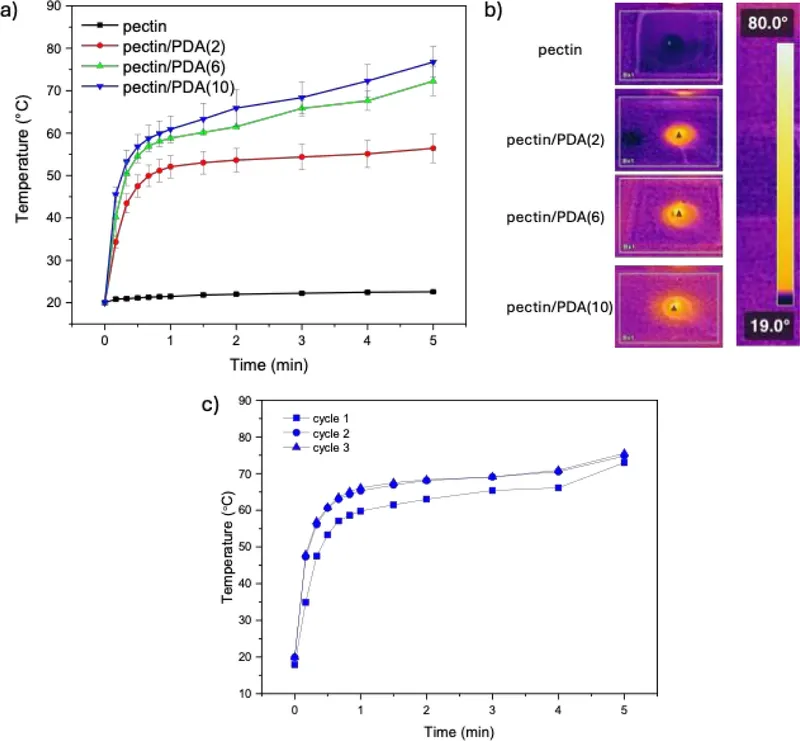
| Gel temperature after 5 min of 808 nm light (most polydopamine) | 75 °C | Plain pectin: no temperature rise |
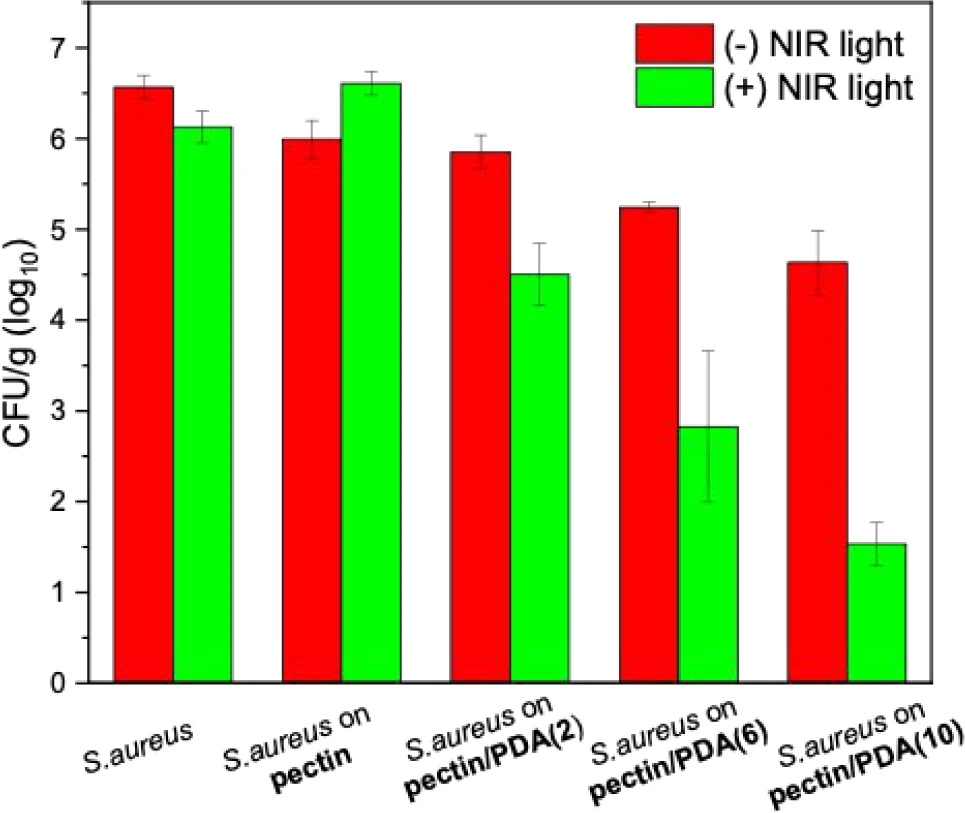
| Drop in S. aureus viability after irradiation (≈ 99.9 %) | ~3 log | Plain pectin: no significant effect |
If a dressing can warm up when you need it to, the heat can damage bacteria without any drug. Polydopamine, a polymer inspired by the adhesive proteins of mussels, absorbs near-infrared light and turns it into heat.
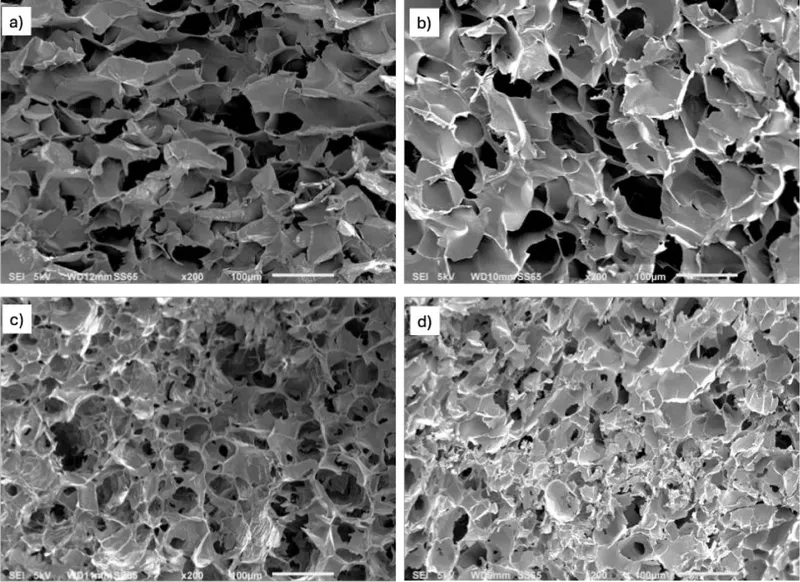
We polymerised dopamine directly inside a pectin solution under alkaline conditions, then cross-linked the network with calcium ions. Polydopamine acts as a second cross-linker through hydrogen bonding and π–π interactions, which makes the gel more flexible. More polydopamine also gives a denser network.
I worked on optimising the synthesis and characterised the gels with SEM / EDX, rheology, UV-Vis and FT-IR.
Under 808 nm light, heating scaled with polydopamine content. The gel with the most polydopamine reached 75 °C within five minutes, while plain pectin did not warm up at all. That heat cut the viability of Staphylococcus aureus by about three orders of magnitude.


Figures: Kölgesiz, S.; Özçelik, N.; Erdemir, N. E.; Ünal, H. ACS Omega 2025, 10 (21), 21994–22004. Licensed CC BY 4.0